What Does TSTS Mean in Text? If you’ve spotted this short acronym in a message and felt confused, you’re not alone. In today’s world of fast-paced digital conversations, text slang evolves quickly, and keeping up can feel overwhelming. Understanding what TSTS means in text can help you stay confident and in the loop when chatting online.
Whether you’re active on social media, texting friends, or browsing online forums, knowing the meaning of TSTS ensures you never miss the context of a conversation. In this guide, we’ll break down what TSTS means in text, where it’s commonly used, and how you can respond naturally when you see it.
What Does TSTS Mean in Texting?
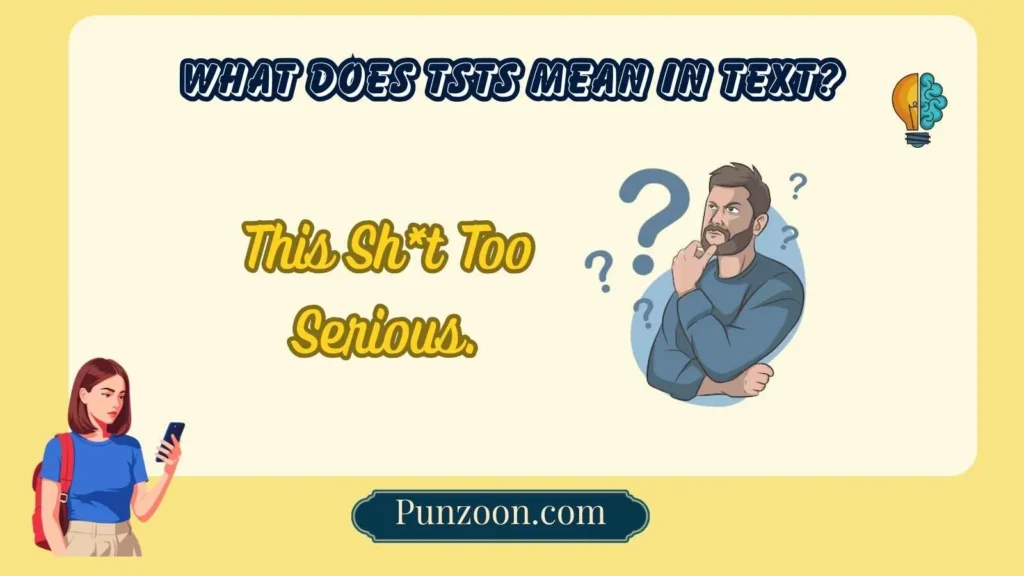
TSTS stands for “This Sh*t Too Serious.”
It’s used to signal that a situation feels unnecessarily intense, dramatic, or overblown.
In plain English, it usually means:
- “You’re taking this too seriously.”
- “It’s not that deep.”
- “Let’s calm down.”
- “Why are we escalating this?”
Breaking Down the Acronym
| Letter | Word | Meaning Contribution |
|---|---|---|
| T | This | Refers to the current situation |
| S | Sh*t | Adds emotional intensity or frustration |
| T | Too | Indicates excess |
| S | Serious | Describes the emotional tone of the situation |
The profanity gives it punch. That punch can make it funny in the right context. It can also make it offensive.
Context decides everything.
The Tone Behind TSTS — What Are You Really Saying?
When someone uses TSTS in a text message, they’re rarely just stating an observation. They’re communicating an emotional reaction.
Depending on tone and relationship, it can mean:
- Light sarcasm
- Playful teasing
- Frustration
- Discomfort
- Emotional avoidance
- Dismissiveness
Same Acronym. Different Feelings.
Let’s compare.
Example 1 – Playful
Friend: “You didn’t reply for 2 hours. I was about to call the police.”
You: “TSTS 😂”
Here, it’s clearly joking.
Example 2 – Dismissive
Partner: “I feel like you’ve been distant lately.”
Response: “TSTS.”
That hits differently. It shuts down emotion.
The acronym doesn’t change. The emotional impact does.
Is TSTS Formal or Informal?
TSTS is strictly informal.
There’s no gray area here.
It contains profanity. It’s slang-heavy. It’s emotionally charged.
Where It Does NOT Belong
- Workplace emails
- Client communication
- Academic writing
- Professional Slack channels
- LinkedIn posts
- Business presentations
Using TSTS in professional settings can:
- Undermine credibility
- Signal immaturity
- Create HR issues
- Damage trust
Even if your office culture is relaxed, slang with profanity rarely lands well in written professional communication.
When Do People Use TSTS?
Understanding when people use TSTS helps you interpret tone correctly.
Common Real-Life Scenarios
- Someone reacts dramatically to a minor issue
- A debate gets heated in a group chat
- Gaming arguments escalate
- A friend overanalyzes a small mistake
- Social media comments become intense
It often appears when someone feels the emotional temperature rising and wants to cool it down fast.
Short Conversation Examples of TSTS Meaning in Text
Casual Friend Scenario
Friend: “You forgot to like my post.”
You: “TSTS lol.”
Tone: Light, playful.
Gaming Chat
Teammate: “Bro you ruined the entire match.”
Player: “TSTS. It’s just a game.”
Tone: Defensive but dismissive.
Group Chat Drama
Person A: “You left me on read.”
Person B: “TSTS.”
Tone: Potentially invalidating.
Why Understanding TSTS Actually Matters
You might think it’s just slang. No big deal.
But digital communication lacks tone of voice, facial expressions, and body language. Words carry more weight.
Misreading TSTS can:
- Escalate arguments
- Hurt feelings
- Damage friendships
- Create unnecessary tension
Communication Fact
Studies on digital communication consistently show that tone misinterpretation is one of the leading causes of text-based conflict. Without vocal cues, people often assume negative intent.
TSTS can easily be read as:
- “Your feelings don’t matter.”
- “You’re overreacting.”
- “Stop being dramatic.”
Even if that wasn’t the intention.
Better Alternatives to TSTS (Without Sounding Rude)
If your goal is to calm things down without dismissing someone, you have better options.
Let’s break them down.
Polite Alternatives to TSTS
These work well in semi-formal conversations or when you want to stay respectful.
- “I think we might be overthinking this.”
- “Maybe it’s not that serious.”
- “Let’s keep things in perspective.”
- “Can we take a step back?”
- “I don’t think this needs to escalate.”
Why These Work
💬They:
- Avoid profanity
- Acknowledge the situation
- De-escalate gently
- Maintain respect
They don’t attack the person. They address the situation.
Professional Alternatives to TSTS
In the workplace, clarity and emotional neutrality matter.
Use phrases like:
- “Let’s refocus on the main issue.”
- “This may not require escalation.”
- “Perhaps we can simplify this.”
- “Let’s approach this calmly.”
- “I don’t believe this warrants further concern.”
Workplace Communication Table
| Situation | Bad Choice | Better Alternative |
|---|---|---|
| Heated email thread | TSTS | Let’s refocus on the main issue |
| Team conflict | TSTS | Let’s approach this calmly |
| Client frustration | TSTS | I understand your concern. Let’s review the details |
Professional communication isn’t about being stiff. It’s about being effective.
Casual Alternatives to TSTS
With close friends, tone can be relaxed.
Try:
- “It’s not that deep.”
- “Relax.”
- “We’re good.”
- “Chill.”
- “It’s all good.”
- “No need to stress.”
These still require awareness. Even casual phrases can feel dismissive during emotional conversations.
Tone Matters — Choosing the Right Phrase
Words are tools. Use the wrong tool, and you break things.
In the Workplace
Keep it measured.
- Avoid slang
- Remove profanity
- Focus on solutions
- Acknowledge concerns
Professional environments value emotional regulation.
In Friendly Conversations
Humor works.
But timing matters.
If your friend is joking, playful language fits. If they’re vulnerable, playful language can feel careless.
In Sensitive or Emotional Topics
This is where TSTS fails most often.
If someone says:
“I feel hurt.”
And you reply:
“TSTS.”
You just invalidated emotion.
Instead, try:
- “I didn’t realize that. Tell me more.”
- “I’m sorry it felt that way.”
- “Let’s talk about it.”
Empathy builds trust. Dismissiveness breaks it.
Cultural and Generational Differences
Not everyone interprets slang the same way.
Generational Divide
- Gen Z tends to use blunt slang casually.
- Millennials use slang but often soften tone.
- Older generations may view profanity more negatively.
Cultural Considerations
In some cultures, direct language feels normal. In others, indirect communication is valued.
Profanity-based acronyms like TSTS may feel:
- Normal in close peer groups
- Disrespectful in formal cultures
- Confusing to non-native speakers
When texting across cultures, clarity wins.
Common Mistakes When Using TSTS
Many people use TSTS without considering impact.
Mistake 1: Using It During Vulnerable Conversations
Never dismiss emotions lightly.
Mistake 2: Sending It to Someone You Don’t Know Well
Tone requires trust. Without trust, it feels rude.
Mistake 3: Posting It Publicly in Professional Spaces
Screenshots last forever.
Mistake 4: Assuming Everyone Knows What TSTS Means
Not all slang is universal.
15 Smarter Reply Examples Instead of Saying “TSTS”
Here are versatile responses you can use depending on context:
- “Let’s not overcomplicate this.”
- “I think we’re reading too much into it.”
- “It’s really not that serious.”
- “We’re okay.”
- “No need to stress.”
- “Let’s reset.”
- “I promise it’s not a big deal.”
- “Let’s breathe for a second.”
- “We can sort this out calmly.”
- “I didn’t mean it that way.”
- “Let’s keep this light.”
- “We’re on the same team.”
- “It’s just a misunderstanding.”
- “I hear you. Let’s talk.”
- “We’ll figure it out.”
Each option carries different emotional weight. Choose intentionally.
Case Study: How One Text Escalated
A college group project chat spiraled when one member said:
“You’re late again.”
The response:
“TSTS.”
The sender meant, “Relax.”
The group interpreted it as, “I don’t care.”
Result?
- Argument
- Hurt feelings
- Screenshot sharing
- Project tension
A simple alternative like “Sorry, traffic was bad. Let’s focus on finishing” would have avoided escalation.
Small word choices. Big consequences.
Should You Use TSTS at All?
It depends on:
- Your relationship
- Emotional context
- Setting
- Cultural awareness
Pros
- Quick
- Expressive
- Relatable in close circles
Cons
- Contains profanity
- Easily misinterpreted
- Can feel dismissive
- Damages professionalism
If your goal is connection, empathy usually beats clever slang.
FAQs:
What does TSTS mean in text messages?
TSTS means “This Sh*t Too Serious.” It signals that someone feels a situation is overly intense or dramatic.
Is TSTS rude?
It can be. The profanity and dismissive tone may offend someone, especially during emotional conversations.
Can I use TSTS at work?
No. It’s informal slang with profanity. Avoid it in professional communication.
Is TSTS commonly used?
It appears in texting, gaming chats, and social media, though it’s not as common as acronyms like LOL or OMG.
What’s a better alternative to TSTS?
Phrases like “Let’s take a step back” or “It’s not that serious” communicate the same idea without sounding harsh.
Conclusion:
Now you know exactly what TSTS means in text.
It’s shorthand for calling something overly serious. In the right context, it can be funny. In the wrong one, it can be dismissive and damaging.
Digital communication lacks tone cues. That means every word carries extra weight.
Before sending slang like TSTS, ask yourself:
- Will this calm the situation?
- Will this sound dismissive?
- Is this the right audience?
Sometimes the smartest response isn’t the shortest one. It’s the one that builds understanding.
Choose clarity over cleverness. Every time.