Last updated on January 28th, 2026 at 06:00 pm
What Does “Ion” Mean in Text? is a phrase you’ve probably seen online and wondered about, and this article breaks it down in a clear and simple way. When people ask What Does “Ion” Mean in Text? they’re usually confused by how fast slang evolves, so this intro gives you a quick and friendly guide. By understanding modern texting slang, you’ll easily catch the meaning the next time What Does “Ion” Mean in Text? pops up in a chat.
In today’s messages and social posts, What Does “Ion” Mean in Text? shows up in different situations, and knowing the real meaning makes conversations smoother. This article helps you decode the slang, recognize context, and avoid misunderstandings. Whether you’re texting friends or scrolling social media, you’ll finally know exactly how to use it.
What Does “Ion” Mean in Text?
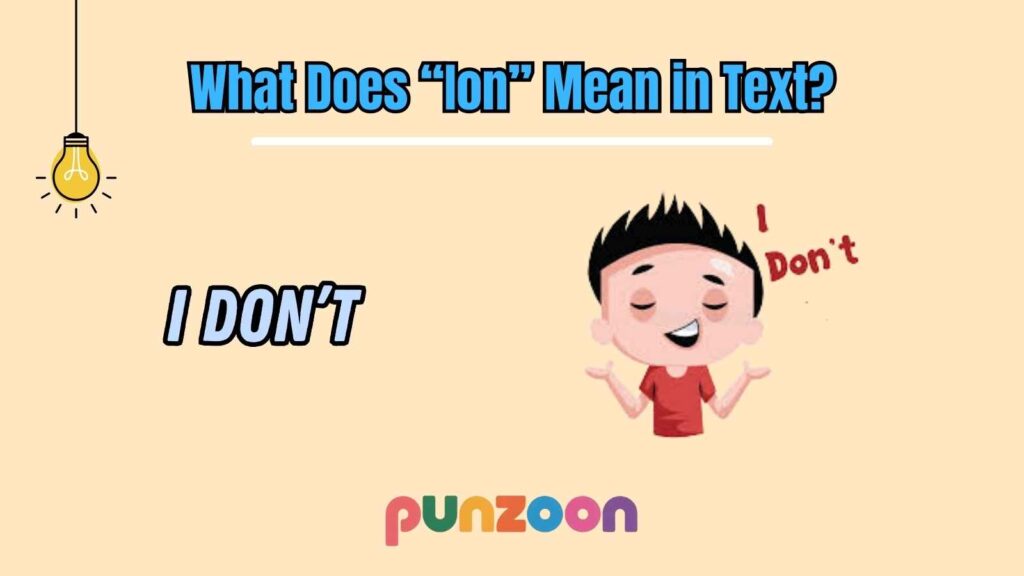
When someone texts “Ion,” they’re almost always saying “I don’t.”
It’s a phonetic contraction used mostly in casual conversations, and it shows up in messages like:
- “Ion like that.” (I don’t like that.)
- “Ion know.” (I don’t know.)
- “Ion care.” (I don’t care.)
- “Ion want to.” (I don’t want to.)
It usually sounds like “eye-on” or “iont.” The meaning doesn’t change—the tone does.
Key takeaway: “Ion” = A fast, slangy way of saying “I don’t.”
How “Ion” Became Popular in Texting and Internet Slang
Language evolves the same way trends do—fast, messy, and unpredictable. “Ion” followed the same path.
Where It Started
“Ion” comes from AAVE (African American Vernacular English) where “I don’t” often sounds like “Ion” or “Ion’t.” Over time, the pronunciation moved into texting.
Platforms That Spread It
Social media accelerated its rise:
| Platform | Role in Popularizing “Ion” |
|---|---|
| TikTok | Captions like “ion care fr” went viral. |
| Twitter/X | Quick, punchy slang for jokes, memes, reactions. |
| Used heavily in comments and DMs. | |
| Snapchat | Short-form texting made “ion” convenient. |
Why It Caught On
- It’s fast to type.
- It sounds natural in conversation.
- It conveys tone—something plain “I don’t” sometimes lacks.
- It feels trendy and youthful.
A simple contraction turned into one of the internet’s most recognizable expressions.
What “Ion” Means in Different Conversation Settings
“Ion” isn’t one-size-fits-all. Its meaning shifts depending on tone, punctuation, and context. Some uses feel joking, others sound cold.
Let’s break down the major categories.
Expressing Dislike or Disapproval
When someone uses “Ion” this way, they’re shutting something down—fast.
Examples:
- “Ion like that outfit.”
- “Ion mess with him.”
- “Ion think that’s a good idea.”
You’ll see this in disagreements, casual roasting, or when someone wants to voice an opinion without softening the blow.
Tone analysis:
Usually blunt, sometimes irritated, occasionally playful.
Showing Refusal or Avoidance
Here, “Ion” acts as a polite (or not so polite) no.
Examples:
- “Ion wanna go today.”
- “Ion feel like hanging out.”
- “Ion have time for that.”
People use it when rejecting invitations, declining offers, or stepping away from responsibility—quickly.
Case Study:
A college student might reply
“ion wanna go to class today fr”
in a group chat to signal laziness, burnout, or lack of motivation.
Indicating Uncertainty or Unawareness
Sometimes “Ion” simply means “I don’t know,” with zero attitude attached.
Examples:
- “Ion know what she meant.”
- “Ion understand this homework.”
- “Ion get it, explain again?”
This version is casual and neutral.
Useful tip:
If someone texts “Ion know…” with dots, they might feel unsure, awkward, or embarrassed.
Displaying Emotional Distance
This is one of the strongest uses of “Ion.” It communicates apathy.
Examples:
- “Ion care anymore.”
- “Ion mind.”
- “Ion feel nothing about that situation.”
This “Ion” often appears in:
- Breakup conversations
- Silent treatment texts
- Arguments
- Cold replies
Quote example:
“Ion care what he says.”
This shows detachment, not confusion.
Common Variations of “Ion” You’ll See Online
Not all versions look the same. Each one has a slightly different tone.
| Variation | Meaning | Tone |
|---|---|---|
| Ion | I don’t | Neutral/Casual |
| Ion’t | I don’t | Stronger / AAVE-rooted |
| Ion t | I don’t | Rare / stylized |
| Ionno | I don’t know | Common & playful |
| Ion care / ion mind | Emotional distance | Blunt |
| Ion want / ion like | Dislike / refusal | Direct |
These variations appear across memes, screenshots, and TikTok audio captions.
When You Shouldn’t Use “Ion”
Even though slang feels fun, it doesn’t fit everywhere. Using “Ion” in the wrong place can create misunderstandings—or worse, seem unprofessional.
Avoid “Ion” in:
Formal settings
- Work emails
- Job applications
- School assignments
- Professional messages
Situations requiring clarity
- Medical instructions
- Legal discussions
- Safety information
Conversations where slang may offend
- Older relatives
- Supervisors
- Teachers
- Clients
Serious emotional conversations
Slang can make you look dismissive when the moment needs maturity.
Example:
Telling a partner:
“Ion care what you feel.”
can escalate an argument instantly.
Better Alternatives to “Ion” Based on Tone and Situation
Choosing the right alternative prevents mixed signals.
Casual Alternatives (Slang / Friendly Chat)
These feel natural in everyday texting.
- “Nah, not feeling it.”
- “I’m good.”
- “Don’t know tbh.”
- “Not really into it.”
- “Don’t like that fr.”
Best for:
Friends, siblings, close relationships.
Everyday Neutral Alternatives
These work in regular conversations—not too formal, not too slangy.
- “I’m not sure.”
- “I don’t want that.”
- “I’m not interested.”
- “I don’t like that idea.”
- “That doesn’t work for me.”
Best for:
Group chats, classmates, acquaintances.
Polite or Professional Alternatives
These keep things clean, respectful, and clear.
- “I’d prefer not to.”
- “I’ll decline, thank you.”
- “I’m uncertain at the moment.”
- “That’s not something I can commit to.”
- “I appreciate it, but I’ll pass.”
Best for:
Coworkers, teachers, employers, clients.
How to Choose the Right Alternative Every Time
When responding, consider four angles:
1. Relationship
Are you talking to:
- A boss?
- A friend?
- Someone you just met?
- Someone older?
Tone changes everything.
2. Setting
Is this:
- A group chat?
- A workplace discussion?
- A debate?
- A casual convo?
3. Emotional weight
Is the topic:
- Serious?
- Funny?
- Sensitive?
- Neutral?
4. Clarity
Will slang confuse the person?
Mini Decision Flow
| Situation | Best Choice |
|---|---|
| Casual with friends | “Ion” / slang phrases |
| Everyday conversation | Neutral alternatives |
| Professional or formal | Polite alternatives |
| Emotional moment | Clear, complete sentences |
A simple rule:
If clarity matters, avoid “Ion.”
20 Useful Replies and Alternatives to “Ion” (With Context Examples)
Here are polished responses you can use depending on the situation.
- “I’d rather not.”
When someone pushes you to join a plan. - “That’s not really my thing.”
Rejecting an activity or idea. - “I’m not into that.”
- “Doesn’t interest me.”
- “That’s not for me.”
- “I’m not comfortable with that.”
Great for boundary-setting. - “I’d prefer something else.”
- “No thanks, I’ll pass.”
- “I’m going to sit this one out.”
- “That’s not something I support.”
- “I’ll have to decline, respectfully.”
- “Let’s skip that.”
- “I don’t feel strongly about that.”
- “Not my vibe.”
Perfect for aesthetic or lifestyle choices. - “I’m opting out this time.”
- “I honestly don’t know.”
Alternative to “Ion know.” - “I’m unsure right now.”
- “I don’t feel like doing that.”
- “I’m not in the mood.”
- “That doesn’t work for me.”
Using these keeps your message clear without sounding robotic or harsh.
Why Understanding “Ion” (and Its Alternatives) Matters
Slang isn’t just trendy—it shapes how people communicate. Knowing what “Ion” means helps you:
- Avoid misreading someone’s tone
- Communicate clearly in digital conversations
- Prevent conflicts born from slang misunderstandings
- Stay aware of evolving language patterns
- Connect better with younger audiences
- Decode memes, captions, and modern texting styles
Language is always changing. Staying updated gives you an edge—socially and professionally.
FAQs:
What does “Ion” mean in text?
It’s slang for “I don’t.” Example: “Ion like that.”
Is “Ion” a rude word?
Not always. It depends on the tone. “Ion care” can feel harsh, while “Ion know” is neutral.
Is “Ion” the same as the chemistry term “ion”?
No. The chemistry “ion” refers to a charged particle. Texting “ion” means “I don’t.”
Can “Ion” mean “I don’t know”?
Yes—“Ion know” is a popular variation meaning “I don’t know.”
Should I use “Ion” in professional settings?
No. Use clear alternatives like “I’m not sure” or “I’d prefer not to.”
Conclusion:
“Ion” is one of the clearest examples of how spoken language transforms into digital shorthand. It’s quick, expressive, and rooted in real conversation patterns. Understanding its meaning—and knowing when to use or avoid it—helps you navigate modern communication with confidence.
Whether you’re texting friends, decoding memes, or learning digital slang for the first time, you now have every tool to understand “Ion” and respond effectively.